ZipGo
Streamlining urban transit planning


/ Background
Cities needed a better way to plan commutes
Urban commuting is chaotic, with outdated transit planning tools adding to the inefficiencies. Planners often face fragmented data, clunky workflows, and a lack of real-time insights, making it difficult to design cost-effective, commuter-friendly routes.
ZipGo set out to change that by creating a smarter, data-driven platform. The goal was clear: empower planners to analyze, simulate, and deploy optimal routes seamlessly, transforming the daily commute into a more comfortable, reliable, and affordable experience for millions.
/ Challenge
Outdated tools made transit planning slow and inefficient
Urban transit planners faced significant hurdles: outdated tools, fragmented data, and inefficient workflows. They struggled to analyze traffic patterns, simulate optimal routes, and balance costs effectively. ZipGo needed a smart, user-friendly platform to solve these challenges and empower planners with seamless decision-making tools.

/ Opportunity
Simplify transit planning and improve commuter experience
By addressing inefficiencies in urban transit planning, ZipGo had the potential to:
-
Streamline workflows and reduce route planning time.
-
Optimize operational costs for better scalability.
-
Enhance the commuter experience with more efficient routes.
This project offered a unique opportunity to simplify complex transit challenges through intuitive design and data-driven insights.
/ Solution
To address the inefficiencies in urban transit planning, I designed a platform that simplifies complex workflows through an intuitive, data-driven approach. The solution focused on three core aspects:

01 Analyze:
-
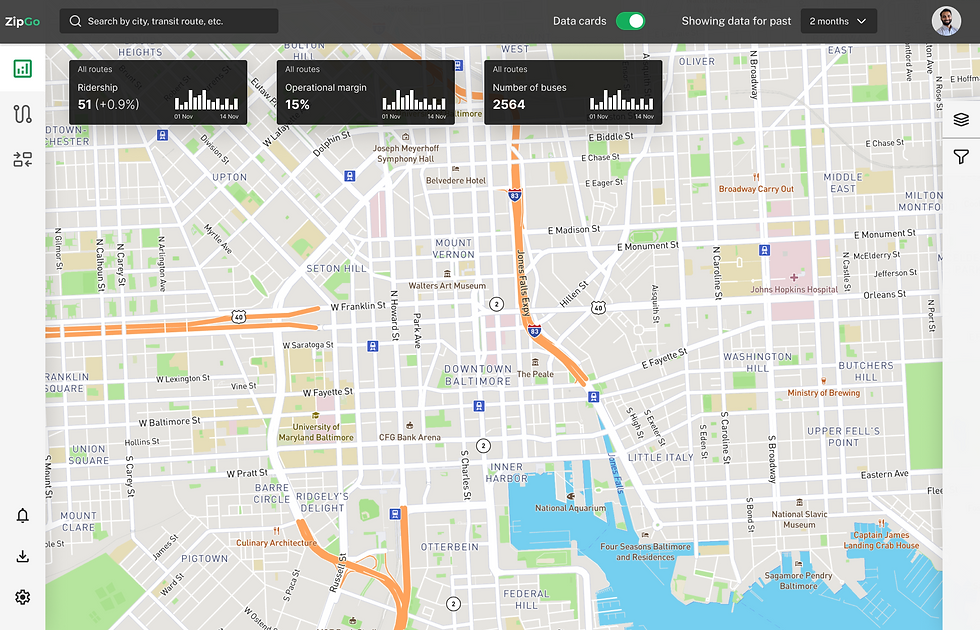
Developed a robust data visualization module to enable planners to view and interpret real-time traffic patterns, population density, and historical route performance.
-
Incorporated filter options and overlays for easy comparison of key data points, ensuring planners could make informed decisions quickly.

02 Create and simulate:
-
Designed tools that allow planners to create optimized routes based on data insights.
-
Integrated simulation features to test these routes dynamically, with visual indicators for travel times, costs, and demographic impact.
-
Enabled real-time feedback during simulation to highlight inefficiencies and suggest improvements, ensuring planners could iterate seamlessly.

03 Deploy:
-
Simplified cost evaluation with automated calculations, helping planners understand operational implications instantly.
-
Streamlined the deployment process, providing guided workflows that reduced the chances of errors and enhanced speed.
-
Included post-deployment analytics to track route performance and allow continuous improvement.
/ Impact
The platform delivered measurable results:
30%
Faster route planning with streamlined workflows.
90%
User satisfaction, as planners found the tools intuitive and efficient.
Improved ZipGo’s operational efficiency and commuter experience.
/ What I learned
Working on ZipGo taught me the importance of designing for diverse user needs—from novice planners to experienced ones. By integrating feedback loops into simulations, I realized the power of real-time iteration in reducing decision-making friction. This project also deepened my appreciation for collaboration, as working closely with engineers and planners helped align design goals with technical feasibility. Lastly, it reinforced that great design is as much about solving user problems as it is about achieving business outcomes.